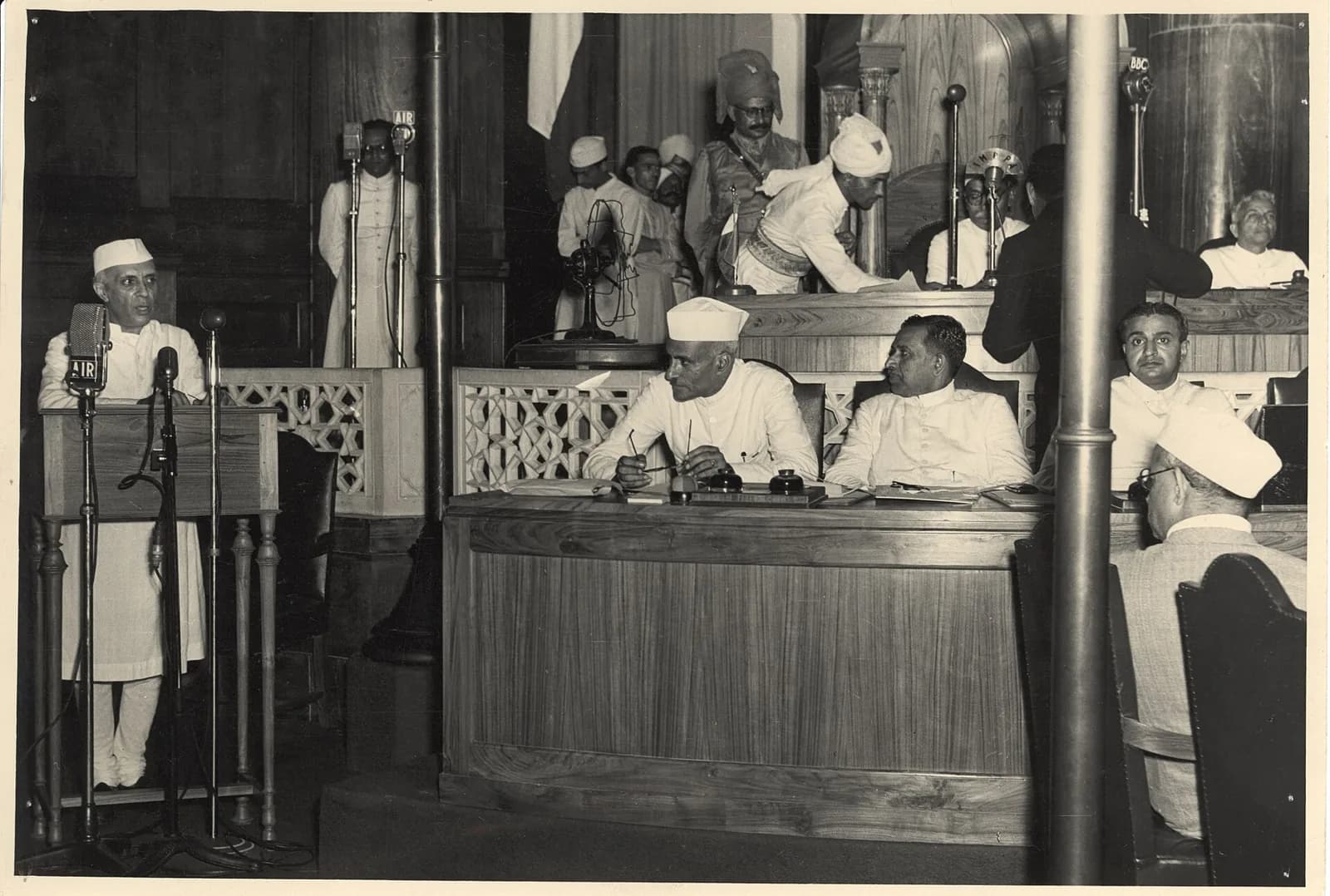
Independence & Partition — 1947

Independence & Partition — 1947

In 1947, India inherited freedom amid Partition, displacement and uncertainty—and began building a constitutional democracy while simultaneously constructing the nation-state.

The Moment

What happened and when?

India became independent on 15 August 1947, alongside the Partition of British India and creation of Pakistan.

The legal basis was the Indian Independence Act, 1947, passed on 18 July 1947. It created the Dominions of India and Pakistan and provided for the division of Punjab, Bengal, administrative assets, armed forces, services and liabilities. Until 1950, the Government of India Act, 1935 served as the interim constitutional framework.

Key dates:

20 Feb 1947: Attlee announced British withdrawal.

24 Mar: Mountbatten became the last Viceroy.

3 Jun: Partition and transfer-of-power plan announced.

14 Aug: Pakistan came into existence.

15 Aug: India became independent; Nehru became PM.

17 Aug: Radcliffe boundary awards announced.

26 Nov 1949: Constitution adopted.

26 Jan 1950: India became a republic.

1951–52: First general elections.

Partition emerged from separate political mobilisations, the Muslim League’s demand for Pakistan, Congress–League disagreements, failure of the Cabinet Mission framework, communal violence and the hurried British withdrawal. Its inevitability remains debated.

The Problem

What challenge existed?

India inherited freedom amid a humanitarian, political and administrative crisis.

Millions of Hindus, Sikhs and Muslims crossed borders amid killings, abductions, sexual violence, forced conversions and destruction, especially in Punjab, Bengal and Delhi. NCERT refers to around 80 lakh displaced people and 5–10 lakh deaths, though estimates vary.

The state had to provide food, camps, healthcare, housing, employment, land and compensation, manage evacuee property, recover missing women and children, and protect minorities.

At the same time, the administration itself was being divided: civil services, police, armed forces, finances, railways, posts, telegraphs, courts, records, buildings, canals and irrigation systems. India also faced food shortages, poverty, weak public health, economic disruption and the integration of hundreds of princely states.

The Choice

What direction did India adopt?

India chose constitutional democracy rather than postponing political participation until development improved.

It adopted universal adult franchise despite widespread poverty and illiteracy. Electoral rolls had to include displaced persons and register women as independent voters.

India also chose a secular, plural conception of citizenship, while retaining existing laws and institutions temporarily within a constitutional framework based on rights, judicial review and accountability.

Territorial integration proceeded through accession, negotiation, administrative mergers and, in exceptional cases, military action, with Sardar Patel, V. P. Menon and the States Department playing major roles.

The Transformation

What changed?

Between 1947–52, India moved from a Dominion to a constitutional republic.

The Constitution came into force on 26 January 1950, establishing parliamentary government, Fundamental Rights, Directive Principles, an independent judiciary, federal institutions and the Election Commission.

The first general elections (1951–52) covered 489 Lok Sabha seats, about 3,283 state seats, around 173 million electors, and approximately 1,32,560 polling stations / 1,96,084 booths.

Despite illiteracy and difficult terrain, ordinary citizens—including women and historically excluded groups—entered democratic politics. Refugee rehabilitation and administrative consolidation strengthened state capacity.

The Unfinished Story

What remained?

Partition left enduring challenges: communal mistrust, minority security, refugee legacies, India–Pakistan tensions over Kashmir, borders, property and water, migration and border management, and the continuing need for communal harmony and institutional impartiality.

Did you know?

  • Radcliffe boundaries were announced two days after Independence.
  • Election symbols helped voters who could not read identify candidates.
  • India remained a Dominion until 1950.
  • The Constituent Assembly simultaneously framed the Constitution and functioned as the legislature.