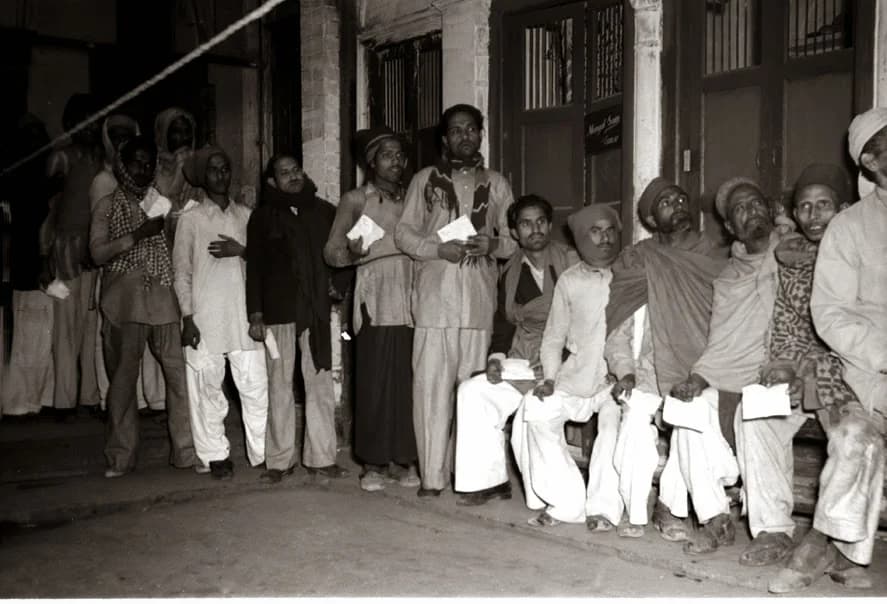
First General Election — 1951–52

First General Election — 1951–52

In 1951–52, India transformed the promise of universal citizenship into the practice of universal voting.

The Moment

What happened and when?

India conducted its first general election between 25 October 1951 and 21 February 1952. It was the first national election after Independence and the first to be held under universal adult suffrage.

Elections were held for 489 seats in the House of the People and approximately 3,283 seats in State Assemblies. The Election Commission conducted the elections through the First-Past-the-Post (FPTP) system, in which the candidate receiving the highest number of votes in a constituency wins.

The Problem

What challenge or condition existed?

The election was an enormous administrative and democratic experiment.

India was a newly independent country with:

widespread poverty and illiteracy;

limited transport and communication networks;

a largely first-time electorate;

displaced populations after Partition;

newly integrated territories and changing constituencies;

little experience of nationwide democratic elections.

The Election Commission had to prepare electoral rolls, delimit constituencies, establish polling stations, train officials, print ballot papers and ensure that citizens understood the voting process.

The challenge was not only to conduct polling but to convince citizens that their vote could influence the government of a new republic.

The Choice

What direction did India adopt?

India chose universal adult suffrage rather than restricting voting rights by property, education, gender, caste or social status.

At the time, the voting age was 21 years. This was a bold decision because many newly independent countries initially limited political participation or introduced it gradually.

India also adopted the FPTP system. It was relatively simple to administer and suited a country beginning with constituency-based parliamentary democracy. However, it also meant that the number of seats won by a party might not exactly correspond to its share of the total votes.

The use of party symbols, ballot boxes and phased polling helped voters participate despite low literacy and difficult geographical conditions.

The Transformation

What changed as a result?

The first general election moved democratic sovereignty from the Constitution into actual electoral practice.

Around 173 million electors were enrolled, excluding Jammu and Kashmir. Polling was conducted through approximately 1,32,560 polling stations and 1,96,084 polling booths.

The election:

established the legitimacy of elected government;

brought ordinary citizens into national politics;

created a system of political competition;

tested the independence and capacity of the Election Commission;

connected Parliament, State Assemblies and citizens through regular elections.

The successful completion of the exercise demonstrated that democracy could function at a vast scale even in a poor and socially diverse country.

The Unfinished Story

What remained unresolved?

The election created a democratic foundation, but representation and participation continued to evolve.

Electoral participation differed across regions, communities and genders.

The FPTP system raised continuing questions about the relationship between votes received and seats won.

Delimitation influenced the balance of representation between states and regions.

Social inequalities affected access to political power.

Money power, political influence, criminalisation and electoral malpractice later became important concerns.

Voter registration, migrant voting, accessibility and accurate electoral rolls remain continuing challenges.

The first election proved that India could hold elections; the larger task was to make democracy increasingly inclusive, representative and accountable.

Did you know?

  • The election took place over several months rather than on a single day.
  • Symbols were used to help voters identify candidates and parties in a largely illiterate electorate.
  • The elections covered nearly one-sixth of the world’s population at the time.
  • The FPTP system used in 1951–52 continues to be used for elections to the Lok Sabha and State Legislative Assemblies.
  • India’s voting age was originally 21; it was later reduced to 18 by the 61st Constitutional Amendment Act, 1988.
  • The first general election became the practical test of whether universal franchise could work in a newly independent country.